
Math Mammoth Addition 1
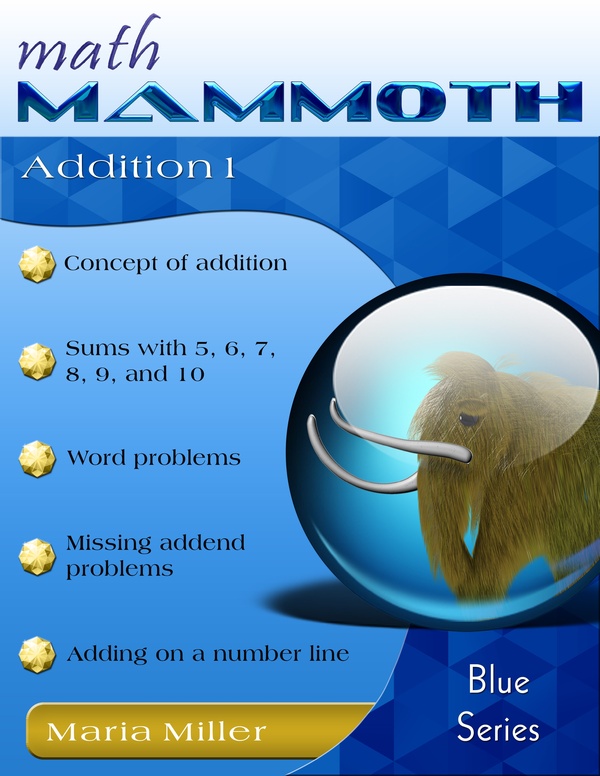
67 pages
(includes answers)
Prices & ordering
PDF download US$4.50
You will be purchasing the download from my authorized reseller Comecero.
Printed copy USD $9.55
Other bookstores (incl. Amazon):
Use ISBN 9781954358614.
 Este libro en español
Math Mammoth Addition 1 is a self-explanatory worktext, dealing with the concept of addition and addition facts within 0-10 (in few occasions numbers between 10 and 20 are used). It is most suitable for first grade.
We start out by reviewing the concept of addition, which has already been taught in kindergarten, in the lesson Basic Addition. The following lesson (Counting on to Add) explains how you can add 1, 2, or 3 to a number by counting on 1, 2, or 3 steps from that number. This is a simple strategy to us adults, but children may need it pointed out.
The next two lessons build on the thought of counting on, as students learn to illustrate sums with jumps on a number line. A number line is an important way to model addition, as it helps to build number sense and will tie in with measurement, later on.
Then, we review comparing numbers and using the symbols >, <, and = to record the comparisons.
Next, we introduce “missing number” problems (e.g. 1 + ___ = 5) over the course of two lessons. These problems are very important, as they connect with fact families and with subtraction.
The child might confuse the missing number problem 1 + ___ = 5 with 1 + 5 = ___ . To help them see the difference, word these problems like this: “One and how many more make five?” You can also model these problems by drawings. In our example of 1 + ___ = 5, you would first draw one stick, and then tell the student, “We need a total of five sticks. Draw more until there are five of them.” The number of sticks that the child needs to draw in order to make five is the missing number. So, you can say, “First there was one stick, then you needed to add (draw) some more to make 5. How many more did you draw?”
Then we come to the lessons titled Sums to.... These lessons practice the number bonds (number combinations) that add up to a particular number. In the case of 5, they are 0 and 5, 1 and 4, and 2 and 3. The goal is to help the child to memorize the addition facts within 0-10.
My approach to memorizing the basic addition facts within 0-10 is many-fold:
- Structured drills, such as used in the lessons Sums to 5, Sums to 6, and so on. In each of these lessons, the child learns the number combinations that add up to the specific number (aka number bonds). This understanding is the basis for the drills. Thus, the drills are not totally random, because they are based on the pattern or the structure in the facts. This will connect the facts to a context, and help the child to better understand the facts on a conceptual level, instead of merely memorizing them at random.
- Using addition facts in games and in everyday life is very helpful — and especially in games, because all children like to play games.
- Random drilling may also be used, sparingly, as one tool among others.
- Memory helpers can be silly mnemonics or writing math facts on a poster and hanging it on the wall. Not all children need these, but feel free to use them if you like.
These addition facts are used constantly in all later math work. I recommend that children become fluent with addition and subtraction facts within 0-10 by the end of first grade.
Before closing the book, we focus on the thought of equality and the usage of the equals sign (=). Many children develop a misconception of the equals sign being an “operator,” as if it means that you need to add/subtract/multiply/divide, or “operate” on the numbers in the problem. A child with this misconception will treat the equation 9 = __ + 4 as the addition problem 9 + 4. The lessons on equality and comparisons focus on preventing that erroneous view, and on building the proper understanding of the symbol: that of denoting equality of what is on either side of the symbol. For example, students will see and work with equations such as 5 = 4 + 1 and 3 + 5 = 4 + 4.
Students also encounter addition tables, number patterns, word problems, and adding three or four numbers. So, while on the surface it may look like that all we do is add small numbers, actually a lot happens! Please also see the following pages for games that I recommend while studying this book. Games are important, as they help children to practice the addition facts and also make math fun.
I have also made a set of videos that matches the topics covered in this book.
The PDF version of this book can be filled in on a computer, phone, or tablet, using the annotation tools found in many PDF apps. See more.
- Connection between Addition and Subtraction
- Single-Digit Addition Practice
- Addition Hidden Picture Game
- "7 Up" Addition Facts
- Fact Families
- Mathy's Berry Picking Adventure
- Bingo Game
- Math Mammoth Subtraction 1 – a worktext about subtraction concept, difference, fact families, addition and subtraction facts within 0-10, and word problems (grade 1).
- Math Mammoth Add & Subtract 2-A – a worktext about "easy" additions and subtractions within 0-100, memorizing the basic addition facts of single-digit numbers, and word problems (grades 1-2).
- Math Mammoth Place Value 1 – a worktext about two-digit numbers (place value), comparing, rounding, even & odd, and graphs (grade 1).
- Free addition worksheets for grade 1 – includes single-digit addition, double-digit addition, adding multiples of ten, and missing number addition problem worksheets.
Customer Testimonials
We have been using the Addition 1 and Place Value 1 books mostly. I give her a page or two at a time and we go over what needs to be done. Then she completes the pages on her own and we review them together the next day.
One of the things I like about Math Mammoth is the many different ways a skill is practiced. Grace has a much better grasp of addition than I did at six, partially because of all the different kinds of practice she gets.
Susan Kincaid
1 December 2008
I am SO THRILLED at how well my daughter is doing with her math now. She is in first grade, and we've been using Horizons all year. We've tried a few other programs, and I was mostly happy with Horizons. The only thing we had trouble with was the part of the lesson where you skip count every day and the 5 minutes with flashcards to memorize addition facts.
My daughter HATES flashcards, and I felt like this exercise (along with the skip counting for numbers like 4,7, etc.) was going in one ear and out the other. She would recite and not retain. It was not working for us, we both began to dread it, and I finally stopped doing it. I figured as long as she could count quickly on her fingers, then she would eventually learn the basic addition facts.
But it started getting harder and harder to get by on that, she was getting frustrated, and math was beginning to go from her favorite subject to her least favorite. So I got your Addition 1 blue book to take a break from Horizons and work on math facts.
We have been so happy with it, that I went ahead and bought a few more blue books to cover the rest of the year, and I'm switching completely from Horizons! I love that it doesn't require a lot of instruction on my part (I have a 4th baby on the way, and this is a HUGE plus!) and that she gets enough practice on a topic at one time. I understood the reason behind the spiral method, but it just wasn't working well for us. And my daughter resisted boring "drill sheets."
I used the number rainbows for the lower numbers, so she could get the idea of the number families [from Add Subtract 2-A book] and we've been playing the card games as well. She was so close to knowing her addition facts, but she hadn't really stopped to think about them--she was just trying to get through each day's assignment (before). Now, I really feel like she's getting it. Breaking them down into each number family has really helped--Horizons didn't do that. And I think she likes it that there isn't this big session of instruction. She doesn't have to sit through something she already gets, and can ask me questions if there's something challenging. I think she really likes the independence of it.
I plan on getting the Grade 2 curriculum next year--you've converted us! I can't believe I've paid so much money for these complicated and time-consuming math programs in the past. Math Mammoth really is a gem and I'll be spreading the word.
Maria Wright
Better Yet - Bundle Deals!
Blue Series - $165 (download)Blue Series for grades 1-3 - $49 (download)
Blue Series for grades 4-5 - $47 (download)
Blue Series for grades 6-8 - $69 (download)
Light Blue Series, grades 1-8 - $225 (download)
Light Blue Series, grades 1-4 - $112.50 (download)
Light Blue Series, grades 5-8 - $112.50 (download)
All Inclusive Bundle - $275 (download)
"Everything" Bundle - $330 (download)
Learn more about the bundles!
*BONUS*: Buy any bundle listed above, and get the fully upgraded Soft-Pak software for FREE (includes 4 math and 2 language arts programs, complete with on screen and printable options).
How and where to order
You can buy Math Mammoth books at:
- Here at MathMammoth.com website — simply use the "Add to cart" buttons you see on the product pages.
- Rainbow Resource carries printed copies for the Light Blue series books.
- Homeschool Buyers Club offers download versions of the Light Blue series, plus the Blue series bundle.
- Homeschool Planet sells the digital versions of the main curriculum and lesson plans to go with them.
- K5 Learning offers download versions of the Blue series.
- TPT sells the Light Blue Series downloads, plus topical units.
- Lulu sells printed copies for most of the Math Mammoth materials (various series).
By purchasing any of the books, permission IS granted for the teacher (or parent) to reproduce this material to be used with his/her students in a teaching situation; not for commercial resale. However, you are not permitted to share the material with another teacher.
In other words, you are permitted to make copies for the students/children you are teaching, but not for other teachers' usage.
Math Mammoth books are PDF files. I recommend you use Adobe Reader to view them, including if you use a Mac. You can try other PDF viewers, but they may at times either omit or mess up some of the images.
Receive my monthly collection of math tips & resources directly in your inbox — and get a FREE Math Mammoth book!

You can unsubscribe at any time.
Math Mammoth TourConfused about the different options? Take a virtual email tour around Math Mammoth! You'll receive: An initial email to download your GIFT of over 400 free worksheets and sample pages from my books. Six other "TOURSTOP" emails that explain the important things and commonly asked questions concerning Math Mammoth curriculum. (Find out the differences between all these different-colored series!)This way, you'll have time to digest the information over one or two weeks, plus an opportunity to ask me personally about the curriculum. A monthly collection of math teaching tips & Math Mammoth updates (unsubscribe any time) We respect your email privacy.
Note: You will FIRST get an email that asks you to confirm your email address. If you cannot find this confirmation email, please check your SPAM/JUNK folder. |
"Mini" Math Teaching CourseThis is a little "virtual" 2-week course, where you will receive emails on important topics on teaching math, including:
- How to help a student who is behind You will also receive: A GIFT of over 400 free worksheets and sample pages from my books right in the very beginning. A monthly collection of math teaching tips & Math Mammoth updates (unsubscribe any time)
We respect your email privacy.
Note: You will FIRST get an email that asks you to confirm your email address. If you cannot find this confirmation email, please check your SPAM/JUNK folder. |
Maria's Math TipsEnter your email to receive math teaching tips, resources, Math Mammoth news & sales, humor, and more! I tend to send out these tips about once monthly, near the beginning of the month, but occasionally you may hear from me twice per month (and sometimes less often). Peek at the previous tips here. You will also receive:
We respect your email privacy.
|
|